Solutions · Hedge Funds
The AI trading stack your ODD questionnaire was written for.
Every fund deploying AI in the investment process now faces the same allocator question: how do you supervise it? Most answers are policy documents. VegaTrade's answer is architecture — the platform was built so that an unsupervised, unexplained, or unreproducible AI decision is not a violation that gets caught, but a state that cannot occur.
Glass-Box AI
Show the investment committee what the model knew.
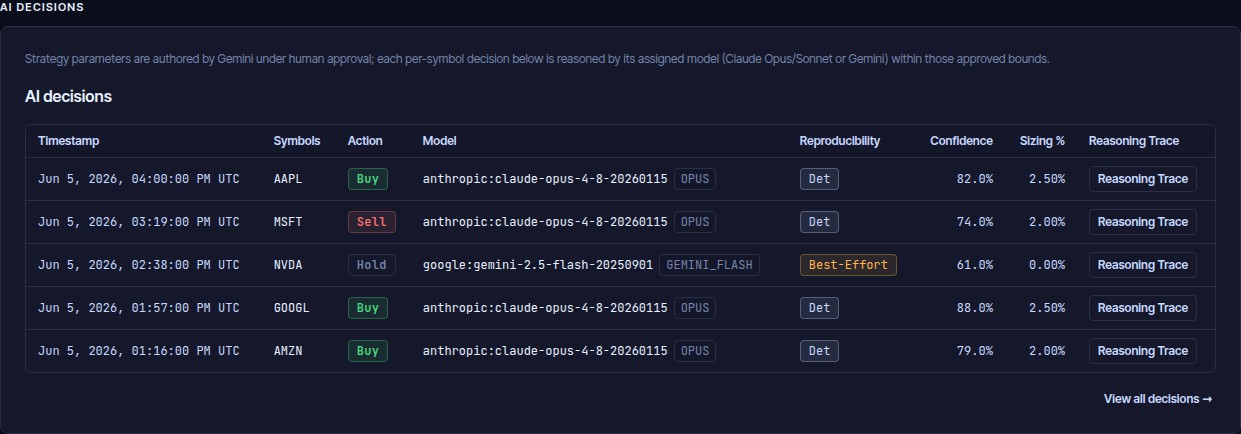
Every AI inference on the platform emits a paired record into the audit chain: the prompt context, model identifier, and an SHA-256 hash of canonical inputs at start; the output, the reasoning, and a reproducibility-class discriminator at completion. The decision your portfolio manager sees in the console is the same record a forensic reviewer reconstructs years later — byte-identical, from immutable storage.
That changes the texture of an ODD conversation. "What was the model's reasoning on the day it cut exposure?" stops being an essay question and becomes a database query.
Strategy Validation
Backtests that charge themselves the full cost of being wrong.
The platform's validation gates encode the anti-overfitting literature as architectural preconditions: walk-forward cross-validation, nested inner cross-validation for hyperparameter selection without peeking, deflated Sharpe ratio to correct for multiple testing, and probability-of-backtest-overfitting. No strategy reaches paper trading without clearing all of them, and the gate verdicts are themselves audit events.
Execution-model fidelity bands quantify what the backtest charges for fills, and once a strategy is live, a continuous backtest-to-live divergence metric tracks whether production behavior is drifting from what was validated — with sustained breach triggering retirement review. Crowding and regime shift surface as quantified deltas, not as quarter-end surprises.
Publishing discipline matches: the platform reports net-of-all-fees Sharpe alongside gross, and after-tax alongside pre-tax for tax-aware strategies. The number that survives diligence is the number the platform leads with.
Supervision
The AI proposes. Your operators approve.
AI-authored strategies are bounded parameterizations inside a constrained grammar — never free-form code — and they enter an approval queue where a human approves or rejects, with both the proposal and the disposition chained. News-driven analysis is propose-only by construction. Per-symbol decisions execute inside approved bounds with per-decision reasoning traces.
The division of authority is the one your compliance manual already wants: models recommend, humans authorize, the chain remembers.
Operations
Risk gates that cannot be routed around.
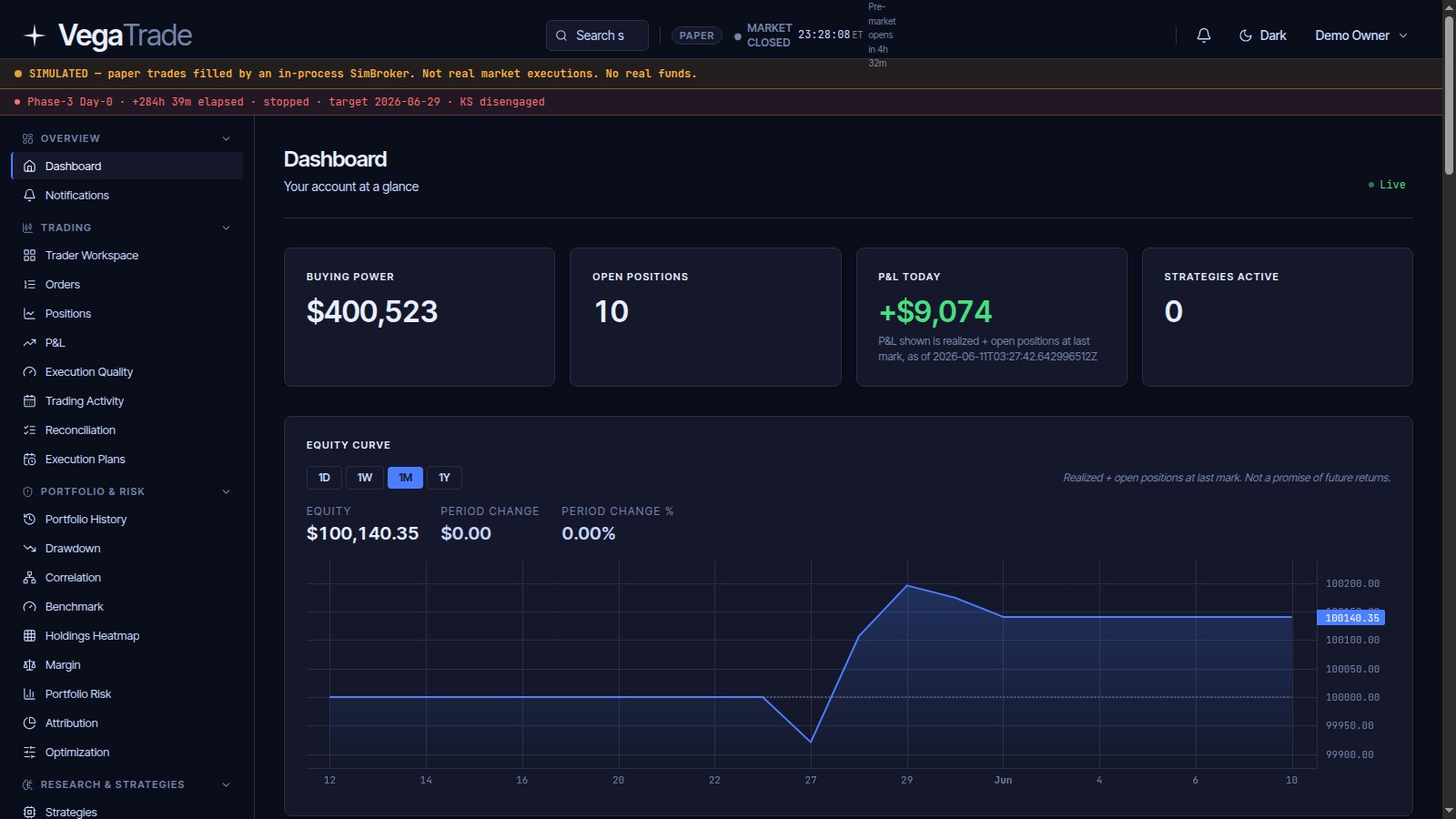
Every order passes a per-tenant risk gateway in the C++ hot path — position-size caps, daily-drawdown stops, order-rate limits, symbol whitelists, and the global kill switch. The gateway is the sole path to a broker; there is no privileged route past it for an operator, an administrator, or a model. Tenants are isolated at the database boundary, and your fund's positions, orders, and strategies are never visible to another tenant by construction.
The platform never custodies fund assets — execution routes to your own broker relationships, and the platform's role is decision, control, and evidence.
Bring your hardest diligence questions.
The platform is pre-launch and onboarding design partners. The procurement conversation — architecture walk-through, audit-chain demonstration, evidence mapping — starts at the contact form.
Request Access